Fall 2025 Quarter
Studio Habits of Mind Framework

Link to framework:
During our Fall Quarter in the MIT program, I began seeking out independently studio frameworks that I was taught in my own college classes in art studios that centered the humanity of students. I knew I wanted to replicate those frameworks within my own classrooms. I was pleasantly surprised to see that Seattle U's own professors also use the framework of Studio Habits of Mind in our Arts Methods coursework specifically design for art endorsed students. In our methods course, we focused heavily on student centered learning and the importance of student choice and agency in our art studios. This aligns with the principles from our review of Evidence of Student-Centered Learning Principles from our fall course Social and Political Context in Schools (Kaput, 2018).
In my oil painting classes at North Seattle, our professor had the Studio Habits of Mind displayed throughout the room. We followed the same flow of lecture/demos, reflection, critiques, and then exhibition as described in the Studio Habits of Mind. My professor emphasized the importance of engaging and persisting through hurdles and constant reflection of one's own work alongside the work of others. This helped me understand the power of centering our humanity as artists in the studio community and how it develops artistic perseverance.
As an art educator, I mirror this same practice of lecture demos, reflection, critiques, and exhibitions as outlined in the Studio Habits of Mind framework in my own classroom. I implemented this framework in every prep period I taught during my student teaching internship. This ensured the humanity of my students by building their deeper thinking skills, pushing them to persevere in their practice, and to self-reflect on how their own forms of expression are being translated into their craft.
This artifact connects to our MIT Strand 3: Learning Environment because it shifts focus away from "classroom management" and recenters the learning environment into one that prioritizes relationship development by working in community as fellow artists. The Studio Habits of Mind provides the framework I need as an anti-racist, humanizing, and sincere future art educator.
Reference:
Kaput, K. (2018, January). Evidence for student-centered learning. Minneapolis, MN: Education Evolving.
Face Jug Lesson Plan "Hook"
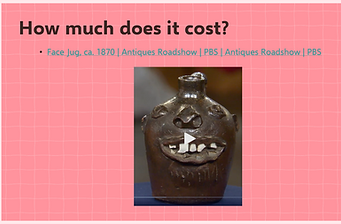
For our very first lesson plan that we had to write during Fall Quarter in our MIT program, our focus was creating a "hook" for our students to heighten engagement and gain their buy-in for the lesson ahead by presenting them with an unanswered question for them to think deeper about the subject at hand. In my Intro to Face Jugs lesson, I start out with a video from Antiques Roadshow where a guest discovers their ugly face jug they found is worth $7k, a shocking value. I then show students an auction house website of face jugs that have been auction for over $100k. This hook draws students in by asking them "What makes these ugly jugs so valuable? They don't look expensive, so what could it be?" This sets the stage for open discussion with my students on how art is valued and provides an entry point for us to dive deeper into "who's culture has capital" as discussed with our MIT program's readings from Yosso (Yosso, 2002).
The lesson then transitions into the dark history of face jugs that can be traced back to a single slave ship that crash landed on Jekyll Island in Georgia. Students then watch a quick video from contemporary artist, Jim McDowell, at his own home studio where he discusses why the tradition of face jugs are important to him as a descendant of an enslaved potter.

This artifact of my intro lesson's "hook" exemplifies MIT Strand 1: Social Justice Identity Development by showing my commitment to being an anti-racist educator through centering the history of enslaved persons in an accessible lesson for students, especially with the understanding that institutions historically have white-washed or ignored the history of the origins of the folk tradition of face jugs in American art. This intro lesson helps students value the cultural capital of the artistry of enslaved persons who overcame incredible circumstances while enslaved by continuing their practice of face jugs from their West African and Jamaican cultures.
Reference:
Yosso, T. J. (2005). Whose culture has capital? A critical race theory discussion of community cultural wealth. Race Ethnicity and Education, 8(1), 69–91. https://doi.org/10.1080/1361332052000341006
Personal Social Justice Statement
During our Fall quarter, we were asked to write our own personal social justice statement as future educators. I chose this as an artifact because it shows evidence of how I have reflected on my own history, identity, bias and racism. This connects to MIT Strand One: Social Justice Identity.
I developed my social justice statement by re-imagining a statement into a 3-part framework of Cultural Competency, Identification, and Critical Thinking. Our roles as educators give us the unique and vital opportunity to be at the forefront of change through our influence and ability to teach students to better understand themselves, their identity, their culture, and critically think about their own roles in our multi-cultural world. The framework I have created described below serves as a critical foundation for instruction that encompasses our learnings from our fall courses and establishes myself as an educator who is an agent for change for social justice by creating critical thinkers who themselves in turn also can become agents of change.
My Social Justice Framework
-
Cultural Competency
-
Because all learning is influenced by cultural differences and developed within culture and community (Nieto, S., 2010), cultural competency is the first part of my vision’s framework. Cultural competency begins with understanding one’s own frames of reference that we know are culturally constructed. After establishing an understanding of one’s own identity and culture, acquiring cultural capital via the appreciation of differing cultures outside of one’s own culture becomes essential (Yosso, T., 2002). When we refuse to acknowledge how culture differs between each other, it negatively influences learning (Nieto, S., 2010). As an educator, focusing on affirming students’ culture(s) and their respective identities creates a safe space for learning by emphasizing belonging over assimilation. It also creates a space where students can explore who they are safely and who others are, which is essential due to the impact culture has on learning (Nieto & Bode, 2020).
-
-
Identification
-
The second part of my vision’s framework is focused on educating students on how to identify forms (including systems) of oppression, especially white supremacy. Culture includes power, which can create blind spots especially for those who are within the established dominate culture (Nieto & Bode, 2020). If we cannot identify and name when cultural power is being abused, we can’t begin to change them. Teaching identification of oppression includes understanding the many contexts, cultures, and language being used during learning. By educating students on these contexts and how to identify forms of oppression becomes essential, especially when their identity is being taken away. As an educator, establishing methods for reclamation of their identity will ensure that their agency remains intact alongside setting the groundwork for dismantling all forms of oppression. This aligns with the lesson that student agency is at the heart of learning (Nieto, S., 2010).
-
-
Critical Thinking
-
By utilizing Deborah Meier’s Habits of mind, myself as an educator can provide a safe space and methods for student reflection, dialogue, and critical thinking. This third part of the framework is focused on working with students to reflect, theorize, and create knowledge (Nieto, S., 2010) by diving deeper into topics. Critical thinking will require scaffolding (Gibbons, 2015) for students, especially MLL (multi language learners) and EB (emergent bilingual) students. This part of my vision’s framework is focused on empowerment, agency, and creating habits of inquiry for students. Through critical thinking, we can begin to determine methods and learnings for combating oppression and all of us becoming agents for social justice.
-
Within my vision, the framework serves as a catalyst for students and teachers to dive deeper together in shared learnings by creating safety and belonging for multi-cultural students. The framework also establishes myself as an educator who maintains high expectations of my students. Post-graduation from this program and into my first years as a teacher, my vision will continue to enhance my anti-racist identity and continue to challenge me as a transformational agent of change for students.
References:
Gibbons (2015). Chapter 1: Scaffolding language and learning (pp. 1-19)
Nieto & Bode (2020). Culture, language, learning.
Nieto, S. Chapter 1: Learning, the social context, and multicultural education, (pp. 33- 49)
Yosso, T., 2002, “Whose culture has capital? A critical race theory discussion of community cultural wealth”
Plyler v Doe Loteria Card
In our Loteria card assignment, I created a card to summarize the importance of the 1982 court ruling from Plyler v Doe supreme court case. In this ruling, all students regardless of race, citizenship, gender, religion, or creed received their secured right to education. The ruling stated that public schools can not deny admission or any other form of discrimination for students. It also outlawed schools from requiring disclosures of the student and/or their families immigration status. Similarly to the importance of the “Supporting Undocumented Students” resource packet in this portfolio, our current educational environment is under attack via ICE detainments, making this supreme court decision more important than ever in our recent history. Reviewing this ruling and discussing as a group in class helps empower us as educators in providing a safe environment for our students. This artifact connects to Strand Two: Authentic Partnerships. Our research, class discussions, and communication strategies gave us many tools for partnering with families, communities, and school personnel to cultivate learning opportunities in pursuit of educating the whole person, especially in our current climate where immigrants are at risk.
